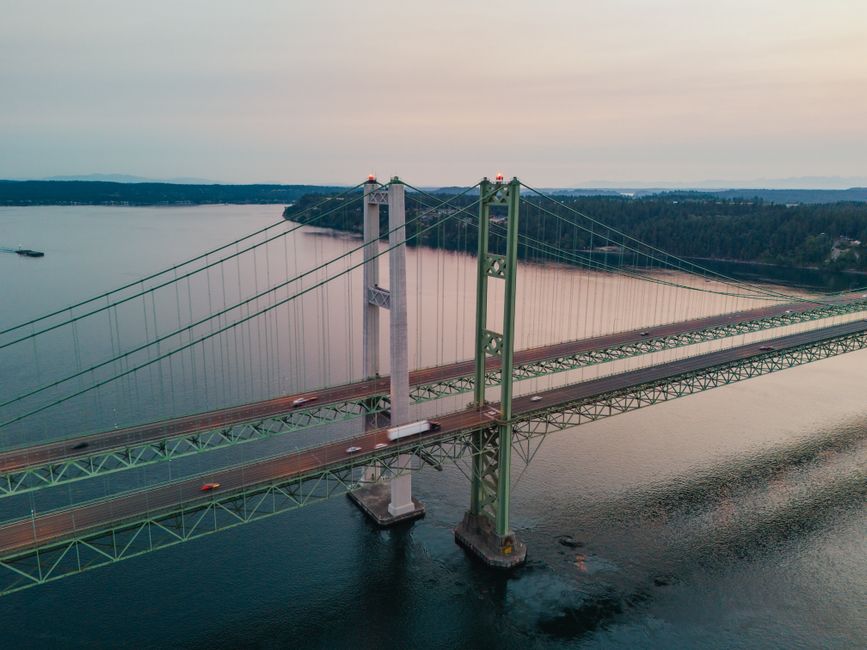
Run a wet finger around the rim of a crystal glass and, if you find just the right speed, the glass starts to sing. You are not forcing it — you are feeding a tiny push of energy into the glass at exactly the rhythm it already wants to vibrate at, and that rhythm builds on itself with every pass of your finger, the note growing steadily louder from almost nothing. On November 7, 1940, something far larger happened on the same principle. A gentle, steady wind blowing across a brand-new suspension bridge in Washington State made the entire mile-long structure twist and heave until it tore itself apart in front of watching drivers and a newsreel camera. It remains one of the most famous stories in the science of vibration.
A Bridge Built to Catch the Wind
The Tacoma Narrows Bridge was thinner and more flexible than earlier suspension bridges of its size, with solid plate girders along its sides instead of the open latticework trusses older bridges used to let wind pass through cleanly. When wind met those solid, slab-like sides, the air didn’t slide past smoothly — it peeled off in alternating swirls, a pattern engineers call a Kármán vortex street. Each little vortex nudged the deck first one way, then the other, over and over, like a series of small pushes on a swing. Locals had already nicknamed it “Galloping Gertie” for the way it rippled even in ordinary breezes, months before the day it finally gave way.
The Scientist Who Helped Explain It
After the collapse, the U.S. government convened a board of engineers to work out what had gone wrong. Alongside Othmar Ammann and Glenn Woodruff sat the aerodynamicist Theodore von Kármán, whose earlier work on swirling fluid flow gave the investigation its vocabulary. His insight was that a structure doesn’t need a violent gust to be pushed into large motion — a small, rhythmic force, repeated at just the right tempo, can pour energy into a system faster than it can shed it. Think of pushing a child on a swing: one small shove, timed right at the top of the arc, does more than a dozen random shoves ever could. That idea, scaled up to a mile of steel and concrete, is the essence of resonance.
Why the Story Keeps Being Retold
Interestingly, the science hasn’t stood still. A more recent computational study in the Journal of Fluid Mechanics shows the collapse likely involved a more complex interplay between vortex shedding and a twisting motion called aeroelastic flutter, rather than simple vortex resonance alone. But the underlying lesson survives every retelling: when a small, repeating input lines up with a system’s own natural rhythm, its effect can accumulate into something far bigger than the push itself. Resonance shows up everywhere from a plucked guitar string to a wine glass to soldiers once being told to break step crossing a footbridge, to the way any small object, crystal included, has a rhythm of its own.
From a Swaying Bridge to a Small Crystal on Your Wrist
We love this story at WellWave Asia because it’s such a vivid, human-scale reminder that rhythm and frequency matter, whether the object in question is a mile-long bridge or something you can hold between two fingers. Each Frequency Infused Crystal Sticker (FICS) is designed to hold a chosen frequency inside a tiny micro-crystal, worn easily throughout your day — tucked into a pocket, pressed onto a phone case, or carried on your wrist — as a simple, affordable way to support a sense of calm, balance, and refreshed energy, no laboratory-scale equipment required. It’s not about shaking bridges; it’s about appreciating how something small, tuned to its own rhythm, can be felt.
