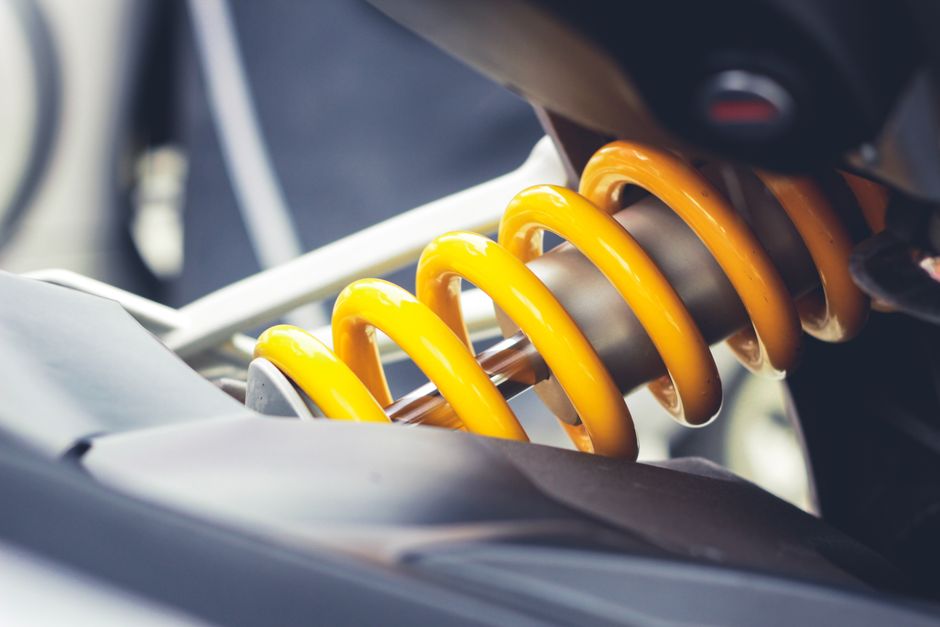
Think of the last time you bounced on an old mattress edge, or watched a garden gate swing shut on its spring, wobbling a few times before settling still. There is a rhythm hidden in that wobble — a beat the spring seems to choose for itself, no matter how hard or gently you push it. That steady, repeating bounce is one of the gentlest doorways into the idea of frequency: the number of times something repeats itself in a given stretch of time.
The Bounce You Already Know
Every child on a trampoline, every screen door easing shut, every rubber band flicked across a room is quietly demonstrating the same principle. Push a spring further and it pushes back harder — release it and it recoils, overshoots, and settles into a wobble with its own particular tempo. Watch closely and you will notice the bounces are not random. They shrink a little each time, but they keep the same spacing between beats, almost like a tiny, fading drumroll. You do not need a laboratory to notice this. You only need a spring, a bit of patience, and a willingness to watch something settle.
A Clockmaker’s Curious Discovery
This everyday bounce fascinated the 17th-century English scientist Robert Hooke, who spent years testing coiled wires, watch springs, and stretched wires to understand how they resisted being pulled or squeezed. In 1678 he published his findings as a simple Latin phrase, ut tensio, sic vis — “as the extension, so the force.” In plain terms: the more you stretch or compress a spring, the harder it pushes back, and it does so in a beautifully consistent, proportional way. This small observation, now known simply as Hooke’s Law, quietly underpins everything from wristwatches to suspension bridges to the springs in your mattress.
Every Spring Has Its Own Steady Beat
Here is the part that connects bounce to frequency. A stiffer spring — think of a tightly wound clock spring rather than a loose slinky — does not just push back harder. It also bobs back and forth faster once released, settling into its recoil more quickly. A looser, softer spring takes its time, drifting through slower, lazier bounces. This relationship between stiffness and speed of oscillation is well documented in physics education resources, including this overview of resonance frequency from ScienceDirect and this University Physics chapter on forced oscillations. In other words, stiffness sets the tempo. Nothing forces the spring to bounce at that particular pace — it simply wants to, given its own material and shape. Add a heavier weight to the same spring and the bounce slows down again, since mass and stiffness are always negotiating the tempo together. That combination, stiffness against mass, is what scientists call a natural frequency: the rhythm a thing settles into when left alone.
Carrying a Steady Rhythm With You
We find this idea quietly comforting at WellWave Asia. Just as a spring’s stiffness quietly sets its own steady, repeating beat, our Frequency Infused Crystal Stickers are built around the idea that small, consistent things can carry a chosen rhythm with them. Each FICS patch holds its frequency inside a micro-crystal, worn lightly on the skin throughout an ordinary day — no wires, no fuss, nothing to plug in. It will not stretch, bounce, or recoil like Hooke’s springs did on his workbench three centuries ago, but the underlying idea rhymes: a small, well-tuned thing settling into its own steady pattern, offered as a companion for calm, ease, and everyday balance rather than a promise of anything more. Next time a door spring wobbles shut behind you, or a trampoline settles after a jump, notice the tempo it chooses for itself. Frequency is not an abstract idea reserved for physics classrooms — it shows up in bounce, in rhythm, in things quietly finding their own steady beat, one recoil at a time.
