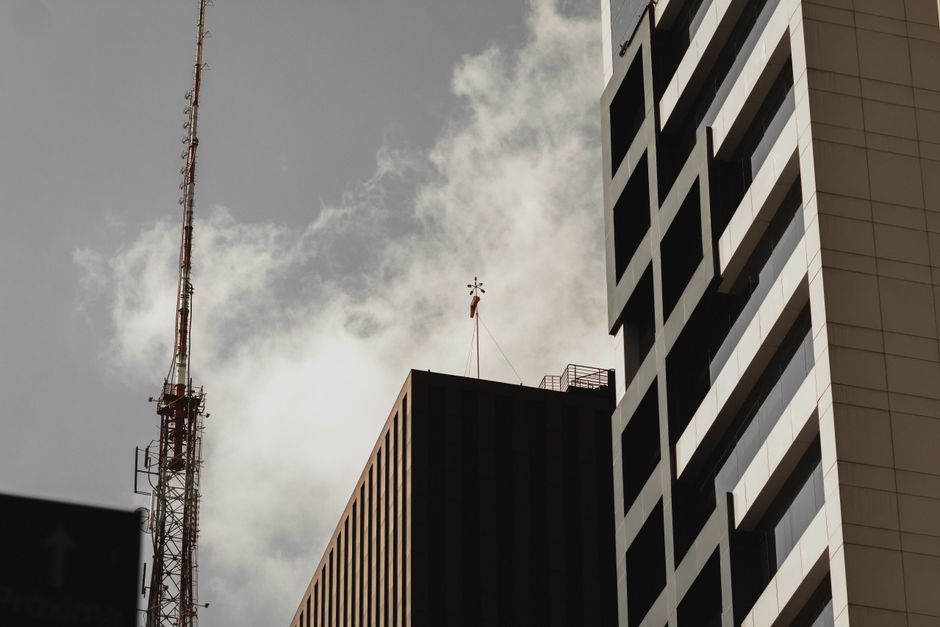
Push a child on a swing at exactly the right moment, over and over, and the arc grows taller almost without effort. Push at the wrong moment and the swing fights you, jerky and small. Every object that can move — a swing, a wine glass, a guitar string, even an eighty-storey tower — has a rhythm it prefers. Engineers call it a natural frequency, and when the wind, or an earthquake, or a crowd of footsteps happens to push at that same rhythm, the motion builds. A skyscraper doesn’t stand still in a storm so much as it breathes with it, swaying gently from side to side. The real feat of engineering isn’t stopping that sway completely — it’s teaching the building how to sway calmly instead of anxiously.
Every Tall Building Has a Favourite Beat
The taller and more slender a building, the lower and slower its natural frequency — think of a long guitar string versus a short one. In steady wind, gusts arrive in irregular little pulses, and if enough of those pulses land near the building’s own rhythm, the sway can grow uncomfortably large, floor by floor, over many minutes. Occupants near the top can genuinely feel it, even though the structure itself is in no danger. The challenge for architects has never been strength alone — a strong wind won’t topple a well-built tower — it’s comfort, keeping the motion small enough that nobody upstairs notices they’re gently swaying with the sky.
Frahm’s Answer: A Weight That Talks Back
The elegant fix predates skyscrapers altogether. In 1909, German engineer Hermann Frahm patented a “device for damping vibrations of bodies” — a secondary mass, tuned to move at almost the same frequency as the thing it was attached to, so its motion worked against the main vibration instead of adding to it. Frahm built it for ships, to quiet the rolling motion in rough seas. The mass sways opposite to the hull’s natural roll, and the two movements partially cancel out. Decades later, structural engineers borrowed the same idea for tall buildings, calling it a tuned mass damper: a giant weight, sometimes hundreds of tonnes, hung or floated near the top of a tower so it swings in counterpoint to the building’s own motion.
From Ships to Skyscrapers to Wrists
The most famous example sits inside Taipei 101, where a 660-tonne steel sphere hangs like a pendulum between the 88th and 92nd floors, visible to visitors through glass. When wind pushes the tower one way, the sphere’s inertia pulls it the other way a fraction of a second later, quietly absorbing energy that would otherwise turn into a noticeable sway. Researchers have spent over a century refining exactly how heavy, how tuned, and how placed these counterweights need to be — MIT’s studies on tuned mass dampers in super-tall towers and ongoing work published in structural engineering journals on optimising damper parameters both trace back to Frahm’s original insight: match the frequency, and even a small counter-motion can calm a much larger one.
Small Tune, Big Calm
What Frahm understood with steel and springs is really a small, universal idea — that a system under strain settles when something nearby is tuned to meet it, rhythm to rhythm, rather than fight it outright. It’s the same principle we hold onto at WellWave Asia, just at a wearable scale. Each Frequency Infused Crystal Sticker carries its chosen frequency inside a tiny micro-crystal, worn quietly on the skin through the day — no towers, no steel spheres, just a small tuned presence meant to sit alongside you as you move through a busy day, aiming for a little more ease and balance amid all the ordinary sway of life.
