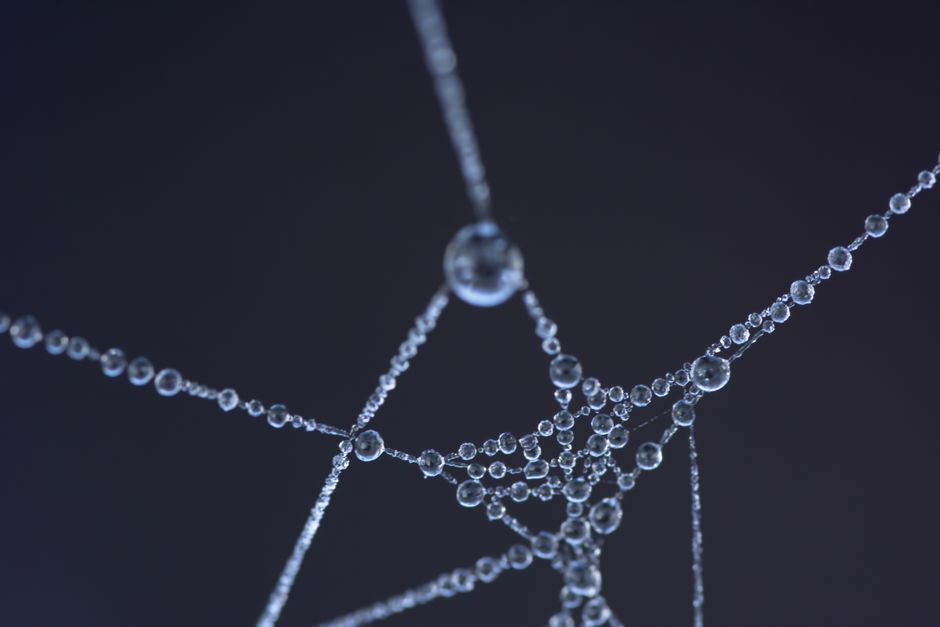
Picture dew clinging to a spider’s web at dawn: hundreds of droplets, each held in its own neat place, catching the light in formation. Now picture a puddle after rain, water pooling wherever gravity happens to push it, with no pattern at all. Leave the web overnight and the dew stays right where it settled; leave the puddle and it spreads and evaporates unevenly, never holding a shape at all. For a long time, most of us pictured the water inside our cells as the second kind — just a formless fluid filling up the gaps between the “important” parts. It turns out that picture is backwards. The water in our cells behaves far more like the dew on the web, held in careful, deliberate formation rather than left to pool.
A Cell Is Not a Water Balloon
It is tempting to think of a cell as a tiny balloon, with proteins and structures floating loosely in a pool of water. But the inside of a cell is dense and crowded, packed with proteins, membranes and fibres — closer to a fully soaked kitchen sponge than an open glass of water. Squeeze a sponge and much of what drips out is loosely held water, yet a surprising amount stays clinging to the fibres themselves, refusing to let go. Cells appear to work on a similar principle: a meaningful portion of the water threading through all that crowding is not simply idle filler. It sits close to molecular surfaces, arranged by the charge and shape of what it touches, forming thin, oriented layers rather than sloshing around at random. Recent work using Raman micro-spectroscopy on living cells, published in Nature Communications, found a distinct population of this “biointerfacial” water clinging to proteins in a thin, more ordered shell — a small but consistent feature across very different cell types.
The Scientist Who Rethought Cell Water
One of the researchers most associated with this idea is the cell physiologist Gilbert Ling, who spent much of his long career studying what actually keeps water and potassium arranged the way they are inside living cells. In his work, Ling proposed that a large share of intracellular water exists in a “polarized, oriented” state — stacked in multiple layers along stretched-out protein chains, rather than moving freely like water from a tap. It was a striking departure from the older idea of the cell as a simple bag of solution, nudging biology toward paying closer attention to structure, not just chemistry.
Water With a Job to Do
Why would organized water matter to anyone outside a laboratory? Because it reframes the cell as an environment built on arrangement, not chaos. Think of a library where every book has its shelf, versus a room where the same books are simply stacked in a heap — both hold the same collection, but only one lets you find what you need. Researchers who study interfacial water at institutions like the University of Washington’s Pollack Laboratory describe surfaces inside the body as constantly organizing the water around them, layer by layer. That quiet, built-in order is part of what allows a cell to hold its shape, keep its contents where they belong, and stay responsive to its surroundings — supporting a general sense of steadiness and ease rather than sluggish disorder.
Bringing a Little Order Back
None of this means we can consciously rearrange the water in our cells — that has always been the body’s own quiet architecture. But it’s a gentle reminder that wellbeing often lives in subtle organization rather than dramatic intervention. That is the spirit behind WellWave Asia’s Frequency Infused Crystal Stickers (FICS): small, wearable patches that hold a chosen frequency inside a micro-crystal, worn as a simple, affordable companion to a calmer, more balanced day. Nothing to swallow, nothing complicated — just a small, orderly addition to a body that was already, quietly, built on order.
