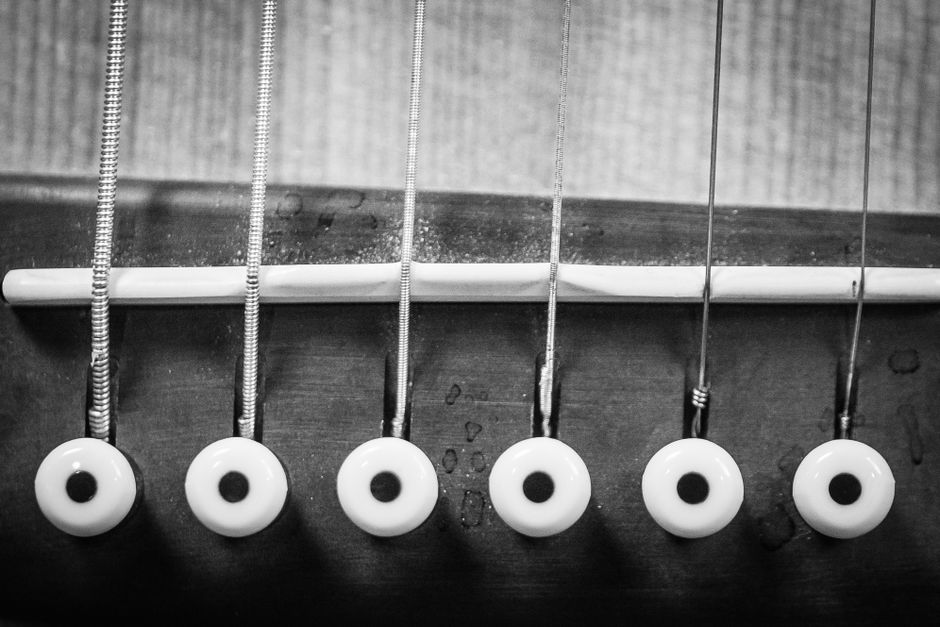
Pluck a guitar string and lean in close: shorten it, tighten it, or swap it for a thicker one, and the note shifts every time. Press a finger on the fretboard to shorten the low E string and it climbs toward a brighter pitch; loosen a peg and the same string sags into a dull, wandering hum. It feels like magic, but it is pure, predictable math humming through the air. Almost four hundred years ago, a French friar sat with a wooden monochord and worked out exactly why — a discovery that still governs every guitar, piano, and taut wire that has ever sung.
A Monk Who Loved Numbers
Marin Mersenne (1588–1648) was a French friar, mathematician, and philosopher best remembered today as a hub connecting the great minds of his era — he corresponded with Descartes and Galileo, passing letters and ideas between scientists who rarely met in person. But his own quiet obsession, the one that changed how we understand sound, was stretched string. In his sprawling 1636 treatise Harmonie universelle, Mersenne measured — patiently, repeatedly, on an actual monochord, a simple wooden box strung with a single wire and a movable bridge — exactly how a string’s length, tension, and weight decide the note it produces. Not theory. Measurement, done by hand, string by string, note by note.
Three Simple Rules
What Mersenne found is now known as Mersenne’s Laws, and they are still taught in physics classrooms today. Shorten a string and the pitch rises in direct proportion — halve the length, double the frequency. Tighten a string and the pitch rises too, but more gently, following the square root of the tension. Make a string heavier or thicker and the pitch drops, again by a square-root relationship. You can hear all three rules at once on an ordinary guitar: the thin, tightly wound high E string rings bright and high, the thick, heavier low E string rumbles low even at similar tension, and clamping a capo across the neck shortens every string together, lifting the whole instrument’s voice a notch higher. Three plain variables — length, tension, weight — quietly deciding every note a vibrating string can make, from the lowest cello growl to the highest piano wire.
Vibration as a Kind of Language
What makes Mersenne’s work feel almost poetic isn’t just the formula, it’s the idea underneath it: every vibrating object — a string, a drumhead, a wine glass rubbed at the rim, even the air inside a flute — carries its own natural frequency, set entirely by its shape and mass. Modern physics still builds on exactly this foundation — that frequency is a predictable, measurable relationship between mass, tension, and geometry. It stopped being a musical curiosity long ago and became a basic language for how energy moves through anything that can tremble, whether that’s a bridge swaying gently in the wind or a tuning fork settling back into stillness after a strike.
From Monochord to Micro-Crystal
We find something genuinely calming in Mersenne’s story — proof that people have long been drawn to the idea that small things carry their own knowable frequency, one that can be measured, tuned, and shared. That same spirit sits behind our Frequency Infused Crystal Stickers (FICS): each one holds a chosen frequency inside a tiny micro-crystal, made to be worn through the day as a gentle nudge toward ease and balance — a little like a string, waiting patiently to find its note.
