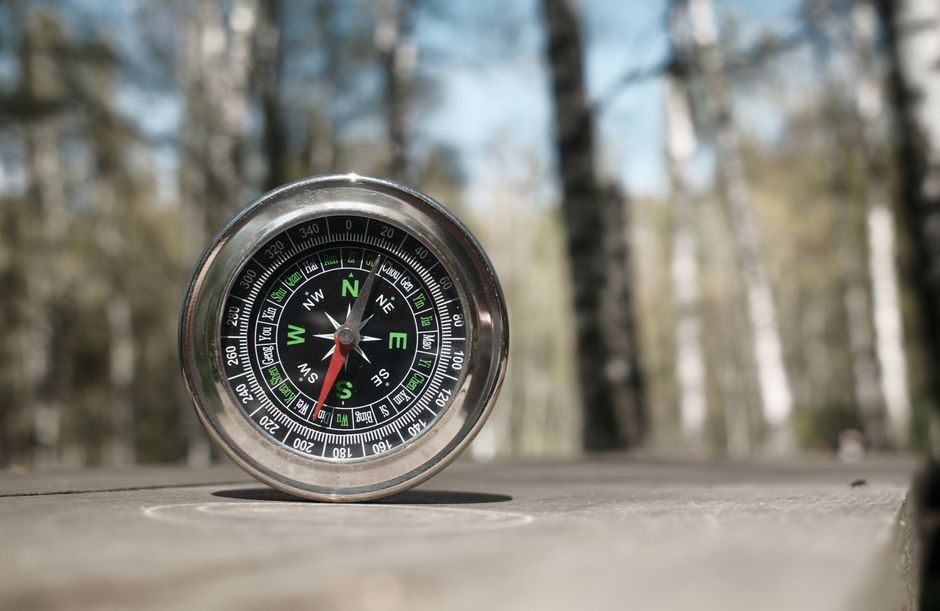
Stand barefoot on cool grass at dawn and you’ll feel the dew, the chill, maybe a breeze. What you won’t feel — but what is there all the same — is a slow, invisible pull moving through your body every second of the day. It’s Earth’s own magnetic field, the quiet force that swings compass needles, steers migrating birds, and wraps the whole planet like an unseen coat. For most of human history, people knew this pull existed. Nobody knew how strong it actually was, in numbers you could write down and trust. That changed because one famously exacting mathematician refused to accept “somewhere out there” as an answer.
A Mathematician Turns His Gaze to the Ground
Carl Friedrich Gauss was already regarded as one of history’s great mathematical minds when, working alongside his colleague Wilhelm Weber at Göttingen, he turned his attention to a very physical question: how strong, exactly, is the magnetic force at any given point on Earth’s surface? Sailors and surveyors had compasses to tell them which way a magnet pointed, but nobody had a trustworthy way to say how hard it pulled. Direction without strength was only half the picture.
Building a Ruler for the Invisible
In 1832, Gauss presented a method that solved this. Rather than comparing one magnet to another — a circular, unreliable approach — he showed that magnetic intensity could be calculated purely from mass, length, and time, using a swinging magnetized bar and a torsion device he helped design. It was the first time anyone had reduced an invisible force to hard, absolute numbers. The work grew into his fuller theory of terrestrial magnetism, later translated and revisited by modern researchers in the journal History of Geo- and Space Sciences.
Why Strength Mattered as Much as Direction
This shift — from simply noting a field exists to actually measuring its intensity — is what turned geomagnetism into a real science rather than a curiosity. Once field strength could be measured the same way anywhere in the world, researchers could compare regions, track seasonal shifts, and build the foundations for the layered, quantitative understanding of Earth’s magnetism that geoscientists still work from today. It’s a reminder that some of the biggest leaps in science aren’t about discovering something new exists — they’re about finally being able to measure something everyone already knew was there.
A Legacy That Still Points True
Gauss’s push for standardized, worldwide magnetic observation helped inspire networks of monitoring stations that, in one form or another, are still running. Today, agencies such as the NOAA National Centers for Environmental Information continue the same basic task Gauss set out to do nearly two centuries ago: tracking the invisible field that surrounds us all, in careful, absolute numbers. Even the unit once used for magnetic field strength, the gauss, carries his name forward.
A Small Nod to an Old Idea
There’s something quietly grounding in knowing that the field passing through your body right now was once painstaking, patient work to even measure. At WellWave Asia, our Frequency Infused Crystal Stickers take that same appreciation for the unseen and bring it down to something small and wearable — a micro-crystal holding a chosen frequency, worn close, as a gentle nod to the invisible forces that have always moved around and through us. No promises, no dramatics — just a quiet reminder that some of the most interesting things in life were never meant to be seen, only sensed, and occasionally, measured by someone patient enough to try.
